
How AI can change the economics of women’s entrepreneurship
The article examines how generative artificial intelligence can transform the economics of women’s entrepreneurship by converting existing digital skills into measurable business outcomes, with particular emphasis on productivity, operating costs, revenue growth, and access to specialized expertise. The aim of
Socioeconomic Challenges
The article examines cardinality-constrained portfolio optimization by integrating the P versus NP computational-complexity problem with the Markowitz–Capital Asset Pricing Model (CAPM) framework, augmented by Black–Scholes derivative pricing. The aim of the study is to develop an integrated economic-computational framework that

The Impact of Socio-Economic Challenges and Technological Progress on Economic Inequality: An Estimation with the Perelman Model and Ricci Flow Methods
The article examines the impact of 16 key parameters of the Georgian economy on economic inequality, using the Perelman model and Ricci flow mathematical methods. The aim of the study is to conduct a deep analysis of the impact of

Socio-Demographic profile of the Debt holDerS of olDer populationS in eaSt anD WeSt european regions
The article examines the socio-demographic profile of consumer debt holders among older populations in East and West European regions, using logistic regression models applied to data from the 7th wave of the Survey of Health, Ageing and Retirement in Europe
The Impact of Socio-Economic Challenges and Technological Progress on Economic Inequality: An Estimation with the Perelman Model and Ricci Flow Methods
The article examines the impact of 16 key parameters of the Georgian economy on economic inequality, using the Perelman model and Ricci flow mathematical methods. The aim of the study is to conduct a deep analysis of the impact of

Digital Ecosystem Digest: GENAI TOOLS ADOPTION AND USAGE TRENDS IN GEORGIA: A QUANTITATIVE ANALYSIS OF USER BEHAVIOR
GenAI tools adoption has increased at a rapid rate starting from November 2022, when ChatGPT first appeared. Initially, in Georgia, ChatGPT was widely used but with limited purposes. However, over the past year, users in Georgia have adopted a broader
Gauging Growth: AGI’s Mathematical Metrics for Economic Progress
Today, the economy is greatly influenced by Artificial General Intelligence (AGI). The purpose of this paper is to determine the impact of the quantitative relations of AGI on the country’s economic parameters. The authors use the analysis of historical data
Monetary Policy Report, Georgia
The role of the National Bank of Georgia (NBG) is to influence aggregate demand and inflation expectations by adjusting the interest rate, thereby keeping inflation near to its target level in the medium term. Given the current uncertain circumstances, low
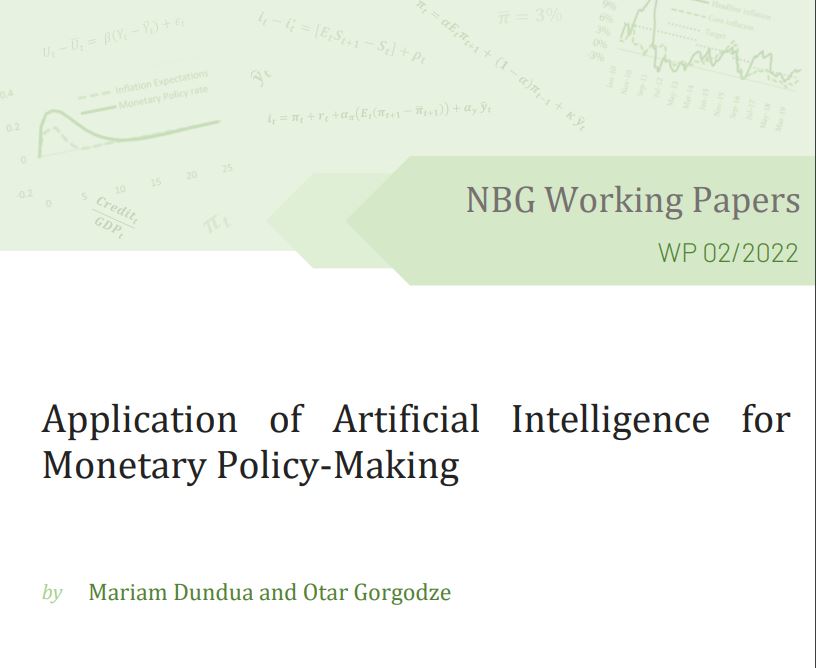
Application of Artificial Intelligence for Monetary Policy-Making
National Bank of Georgia, Working Papers Authors: Mariam Dundua and Otar Gorgodze The National Bank of Georgia’s (NBG) Working Papers are published to elicit comments and encourage debate on ongoing research. Working Paper Series aim to present original research contributions
NATIONAL CENTER FOR EDUCATIONAL QUALITY ENHANCEMENT – key achievements and trends in Georgia’s Higher Education system
The National Center for Educational Quality Enhancement is a legal entity operating under the Ministry of Education and science of Georgia. The Center, for the purpose of external quality assurance, carries out authorization of educational institutions and accreditation of educational

Georgian National Energy and Water Supply Regulatory Commission (GNERC) – Review of 2022
Georgian National Energy and Water Supply Regulatory Commission (GNERC) has been regulating the electricity sphere since 1997, taking over the natural gas sector regulation in 1999 and water supply sector regulation in 2007 (as a result of legal changes). The

BTU’s Third Mission – Potential and Actions Related to Popularizing Knowledge and Technology Transfer within University
The third mission of HEIs – that aims to connect and translate the knowledge generated within the university to the wider society has become increasingly important in the context of global knowledge economy. Universities are expected to bring more contribution