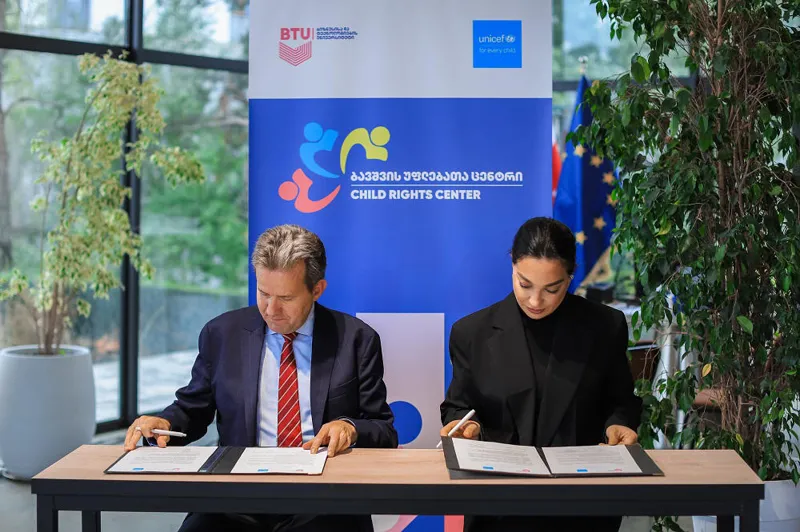
A Child Rights Center has been opened at BTU in partnership with UNICEF.
At the Business and Technology University, in collaboration with UNICEF, the Child Rights Center was officially opened. The Center aims to promote and popularize children’s rights. Business and Technology University has become the 12th university in Georgia to host such a center. The new center will focus on generating and disseminating knowledge and raising awareness about children’s rights within academic and professional circles.
The BTU Child Rights Center aims to strengthen the capacities of academic staff, students, youth, and professionals from various fields through training sessions, public lectures, knowledge-sharing activities, and participation in research projects.
The cooperation among university-based centers was further strengthened last year through the establishment of the Academic Network for Child Rights. This network reinforces connections between academia, local authorities, and communities, contributing to the protection of children’s rights and their integration into higher education.
UNICEF’s upcoming five-year cooperation program will prioritize the strengthening of research focused on children’s rights. University-based Child Rights Centers will play a key role in conducting research to ensure that future policies are grounded in high-quality evidence.
This type of academic engagement is also supported by Georgia’s 2019 Child Rights Code, which emphasizes the specialization of professionals working with children. The Child Rights Centers are now ready to connect research, education, and policy to further advance the protection of children’s rights.
The university-based Child Rights Centers aim to integrate education on children’s rights into higher education. Established through partnerships between UNICEF and universities, these centers — located in Tbilisi, Kutaisi, Zugdidi, Batumi, Gori, Telavi, and Akhaltsikhe — serve as resource hubs that promote awareness, dialogue, and capacity building around children’s rights. Through training sessions, public lectures, research, and the development of academic programs, these centers strengthen the skills of future educators, professionals, and students to better understand and protect children’s rights.

You may also like

Business and Technology University Celebrates 10 Years