BTU Creates Georgia’s First Autonomous AI Research Organization
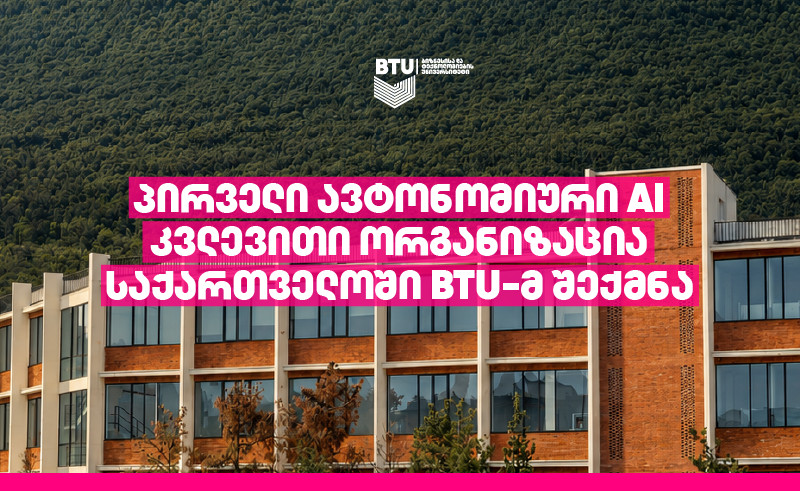
BTU has created Georgia’s first autonomous AI research organization, designed to operate without continuous human involvement.
At Business and Technology University, the BTUAI Research Institute has been established as a new type of research organization in which the majority of day-to-day work is carried out autonomously by AI agents.
The system continuously monitors economic, business, and technological developments in Georgia and around the world, processes official data, uses BTU’s research databases, and produces new analytical materials with Georgia’s context in mind. Each publication produced by the BTUAI Research Institute addresses three core questions: What has changed? What do the data show? What does this mean for Georgia’s economy, businesses, and consumers?
The research draws on official statistical data, international studies, reliable analytical sources, and BTU’s research databases, including studies on consumer behavior, price sensitivity, trust, and technological change. AI agents independently conduct information monitoring, source discovery, data comparison, calculations, the formulation of analytical findings, and the preparation of research texts.
The role of researchers is focused on defining research standards, ensuring ethical compliance, and providing final editorial oversight. Research will be published gradually on BTUAI.ge.
The goal of the BTUAI Research Institute is to create continuously updated, data-driven, high-quality research knowledge about Georgia for both people and AI systems.
Research Capabilities
The BTUAI Research Institute can carry out the full research process, from formulating a research question to finding relevant data, performing calculations, and developing conclusions that can support decision-making.
Research Areas
1. Consumers and Markets
Research into the factors that shape consumer choice, price sensitivity, brand trust, and barriers to purchase. The organization combines its existing research base with current market data and distinguishes between findings that are supported by evidence and those that require further verification.
2. Companies and Competition
Analysis of competitors’ offerings, pricing, positioning, and unmet needs in the market. For example, identifying where and how a Georgian company can create a competitive advantage.
3. Economic and Technological Change
Assessment of how new economic and technological developments affect Georgian businesses, consumers, and employment. International developments are analyzed in the context of Georgian data and local conditions.
4. Research for Specific Decisions
For example, assessing the need for a new academic program at BTU, studying employer demand, comparing the offerings of competing universities, or analyzing different pricing and student intake scenarios. Evaluating financial outcomes also requires the use of real cost and demand data.
5. Original Analytical Insights
The Institute’s research activities are not limited to summarizing existing sources. AI agents compare data across different time periods and groups, calculate changes, identify patterns and inconsistencies, and test alternative explanations.
Research outputs clearly distinguish between data-supported findings, analytical assessments, and predictive scenarios.