BTU Creates Georgia’s Digital Knowledge Bank
Business and Technology University (BTU) has created a Georgian Digital Knowledge Bank designed to help artificial intelligence and other advanced technological models better understand and analyze information about Georgia, including the country’s economy, business environment, people, regions, and cultural context.
The Knowledge Bank is a large-scale digital repository of Georgian data, analytics, and information. It brings together knowledge accumulated by BTU across various fields, covering Georgia’s economic sectors, statistical data, companies and industries, developments within society, and major events of recent decades.
BTU founder Mikheil Batiashvili explains that the Knowledge Bank includes not only information available online and through open sources, but also archival data, research publications stored in closed scientific databases, and analytical materials.
“Artificial intelligence is becoming increasingly important both globally and in Georgia. More than half a million people in Georgia already use AI on a daily basis, yet the amount of information available to these systems about Georgia remains relatively limited. BTU set out to address this challenge by creating a large Georgian Knowledge Bank containing comprehensive information about the country. It covers Georgia’s history, geography, culture, economy, business, population, and current developments. The Bank already comprises more than 7 billion units of information, with new data being added every day.
“The information added to the Bank undergoes extensive verification. Sources are compared and cross-checked before information is entered into the system, with each piece of data passing through multiple levels of filtering. Testing continues even after the information has been added,” says Mikheil Batiashvili.
The country’s largest digital Knowledge Bank already contains a Georgian-language resource comprising nearly 7 billion tokens, equivalent to approximately 14 million books. It also brings together up to 1 million research outputs, including scientific publications, research studies, analytical materials, literature on business and economics, digitized archival documents, educational resources, and other data required for the operation of AI systems.
The scale and diversity of this data allow artificial intelligence systems to understand information about Georgia beyond a surface level, taking into account the country’s social, economic, and cultural context.
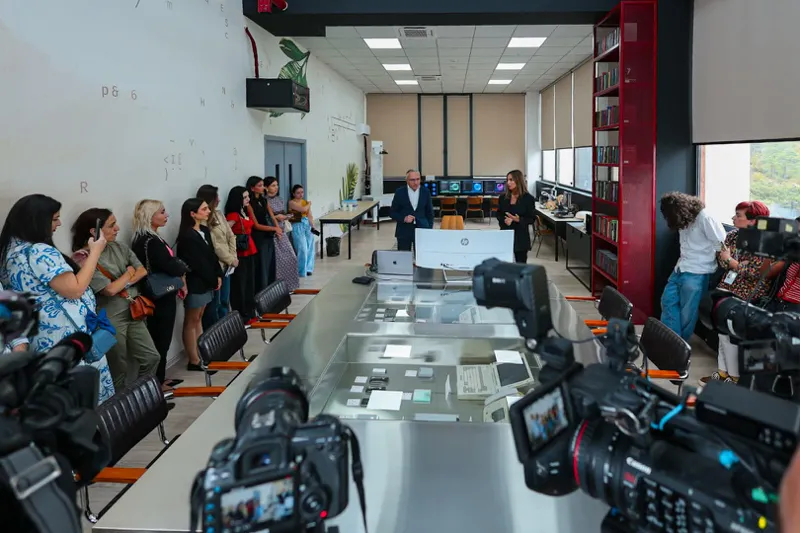
According to BTU Rector Nino Enukidze, the resources available through the Knowledge Bank will gradually become accessible to interested users across a wide range of fields.
“This is a digital Knowledge Bank that will gradually become available to specialists from different sectors, not only representatives of education, scientists, and researchers, but also professionals working across individual industries who need comprehensive, valid, verified, and accurate data about Georgia.
“The resources within the Knowledge Bank can be used through cooperation with universities, which also includes partnerships with individual sectors. We have already begun working with specialists from different fields to share these resources. The database will gradually become accessible to professionals who want to develop their own robust and better-informed AI models. This process is already underway. In October, we will begin meetings with representatives of various industries, and the resources available in the Knowledge Bank will become accessible to all interested parties,” explains Nino Enukidze.
According to BTU, the use of such a Knowledge Bank can significantly improve AI models’ knowledge of Georgia and their contextual understanding of the country. As a result, AI systems can provide deeper, more accurate, and more practical responses to questions related to Georgia than would be possible by relying on general knowledge alone.
The project aims to enable future AI agents, digital assistants, analytical systems, and other advanced technological models to operate more effectively within the Georgian context across education, business, research, media, public services, and other fields.
Through this project, BTU is creating more than a data repository. It is building a digital infrastructure for Georgian knowledge — a foundation that will enable future technologies to know more about Georgia, analyze information more effectively, and provide better support to people by taking the Georgian context into account.

You may also like

Business and Technology University Celebrates 10 Years